Tuesday, April 3, 2012

Book Review

Personality and Situational Factors as Predictors of Alcohol Use by College Students
 
Clara Gruen & Karen Hooker
Doug Davis, Advisor
Haverford College
Department of Psychology
May 2000
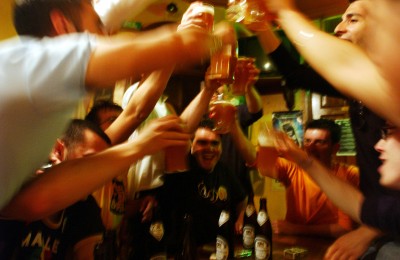
 

According to the college alcohol study conducted by Haverford College, the role of personality plays a huge part in the behaviors exhibited while individuals become intoxicated.  Studies found that different types of personalities correlate either positively or negatively with the drinking patterns of students.  The study broke down the personalities into "neuroticism, extraversion, openness/intellect, agreeableness, and concientiousness" and based on these groupings scientists could determine the likelihood and frequency of alcohol use among students.  

Neuroticism, or emotional stability. It includes the traits of anxiety, anger and hostility, depression, self-consciousness, impulsiveness, and vulnerability
 
Extraversion includes traits such as warmth, gregariousness, assertiveness, activity, excitement seeking, and positive emotions
 
Openness to Experience includes the facets fantasy, aesthetics, feelings, actions, ideas, and values

Agreeableness includes the traits trust, straightforwardness, altruism, compliance, modesty, and tender mindedness
 
Conscientiousness includes the personality traits of confidence, order, dutifulness, achievement striving, self-discipline, and deliberation

The researchers also examined the scenarios in which students commonly used alcohol. "Drinking Situations: The top six reported situations for drinking were small party (3-10 people), room with friends, pre-party, campus party, bar or club, and restaurant."  Based on these situations, the researchers created data that represented the behaviors exhibited in a variety of possible environments.
 The results: "Main effects for personality were found. The dimensions of Extraversion, Agreeableness and Openness were found to both correlate with and predict alcohol use." The other personality traits showed a negative correlation with drinking alcohol so the researchers concluded that there is strong evidence supporting the role of personality when it comes to drinking. 

Conclusions
This research found main effects for personality and situational factors as predictors of alcohol use by college students. This study is particularly valuable with its addition of a complete personality measure to the study of alcohol use by college students. It also used a more in depth look at situations than some previous studies. Its significant findings for the different personality scales and for situations and reasons is an important addition to the previous research on this topic. Future research should be done to explore some of the factors not concentrated on in this study, such as gender, to find a better measure of situations and reasons to predict alcohol use, and to compare this sample to other samples in terms of personality and alcohol use.

Davis, Doug. "Personality and Situational Factors as Predictors of Alcohol Use by College Students." Haverford.edu. Haverford College Department of Psychology, May 2000. Web. 3 Apr. 2012. <http://www.haverford.edu/psych/alcohol%20study/alcoholstudy.00.summary.html>.


below is a brief resume of Douglas A. Davis: the administrator who supervised the experiment
     1981 - 1983: Postdoctoral Fellow, Department of Anthropology, Harvard University: Harvard Adolescence Project
·         1974 Ph.D., University of Michigan, Ann Arbor: Personality Psychology
·         1966 B.A., University of Minnesota, Minneapolis: Psychology
Occupational History
·         2006-present Emeritus Professor of Psychology, Haverford College
·         1972-2006 Department of Psychology, Haverford College
Courses taught:
·         Foundations of Personality
·         Adolescence
·         Adolescence lab
·         Theories of Personality
·         1972 Trainee Development Officer, U.S. Peace Corps Training (India)
·         1971 Cross-Cultural Coordinator, U.S. Peace Corps Training (Morocco)
·         1967-1970 Teaching Fellow, University of Michigan  
(http://www.haverford.edu/psych/ddavis/d2vita.html)


Monday, April 2, 2012

Research Proposal

                                                                        Topic
    As college life and student culture continues to change with the current times, students are gradually evolving into a new and very unique generation.  It is obvious that modern factors such as demographics, economic class, past experience, future goals, and social life all change the way in which students function throughout their college years.  But no matter where a student is from, how old they are, or what they plan to do in life, the consumption of alcohol is still extremely relevant.  While it is generally understood that college students like to participate in underage drinking due to social reasons, many are unaware of the major impacts it has on the student population.  In most cases, the general population accepts the use of alcohol among college students. It is widely tolerated and in many ways, expected to happen.  And while most of us understand the psychical consequences of excessive drinking, many are still blind to the effects it has on the overall student body.  Experts believe that alcohol is responsible for the poor actions and behaviors of students.  Alcohol is said to cause violence, unsafe sex, poor grades, depression, anxiety, and for students to miss classes or even drop out of school.  But what if alcohol is merely the catalyst for these problems?  What if these things would occur naturally on their own without the consumption of alcohol?  Could it be that today’s generation is more rebellious, independent from authority, or perhaps less mature?  Then again, maybe it is the lack of federally-funded prevention programs being provided at universities.  As more and more schools across the country are becoming privatized, less programs are now available to aid in the prevention of underage and excessive drinking among college students.

                                                                  Question
Is alcohol responsible for many of the problems faced by college students, or does it simply amplify pre-existing problems within the individual?  How is student life affected morally, socially, and academically by alcohol?  And is alcohol use more likely to happen in private institutions?

                                                        Theory
    According to many recent studies and surveys taken around the country, which interviewed thousands of college undergraduates,  many students believe alcohol can be used as an excuse in order to maintain a good status in the eyes of the public.  Meaning, if an individual believes they are a “good” person, when they get drunk and act immaturely, they can simply blame their actions on alcohol.  An article in USAToday found that alcohol is a great excuse for students to use when they take part in behaviors they are not proud of.  An excerpt from the article,  written by Sharon Jayson, states, “‘I was drunk so I hooked up with that guy’ ‘I was drunk so I missed my class in the morning’ ‘I was drunk so I got in a fight.’ If it’s something they’re not proud of, it gives them an excuse.”  So based on this detail I have become increasingly interested in finding whether or not underage drinking happens due to individual personality or if it has something to do with the environment.
The average binge drinker statistically reports having more stress and also struggles academically.  But how can it be that alcohol affects all these students in the same way? Perhaps these students are naturally anxious people and academics are harder for them than for the remaining population.  A major study conducted by collegedrinkingprevention.gov concluded that an individuals personality is a major factor in the behaviors observed when he or she is drunk.  It is said that underlying personality traits are drastically exaggerated when the individual becomes inebriated.  A typically happy individual will become friendly, empathetic, and talkative while intoxicated while a moody or aggressive individual will become violent, agitated, or upset when drinking.  Clearly alcohol is not totally responsible for these behaviors.  So when students function certain ways socially, academically, and morally, alcohol can play an important role in the development in these areas.  It is not because of alcohol entirely that these changes may occur, a lot of it has to do with the individual’s mind, experiences, and lifestyle.

                                                                 Process
    As far as similar studies have been executed, I too plan on collecting various testimonies in order to gain a fair understanding of college drinking.  I intend to gather surveys from at least ten students along with the addition of possibly one or two teachers/ faculty members, and also parents of the students.  Within these interviews, I plan to determine the frequency of drinking along with typical behaviors expressed when consuming alcohol.  I also wish to get a decent understanding of the students’ backgrounds and personality based on a series of simple questions that will help me better understand what is taking place on a psychological level.  Based on observation,  I want to see if there is any correlation between drinking behaviors and personality traits.  Like in many of the studies previously taken, I am also interested in finding out the academic history of the participants.  Along with my own studies in the field, I will also be using multiple sources to back up my findings.  With a series of case studies, psychological analyses, surveys, and national statistics, I hope to create a good foundation to base my hypothesis off of.  The research I plan on using will help me determine the effects of alcohol on the student population and will allow me to see any correlation between academics and drinking.  I also wish to see if privatization has anything to do with the drinking “crisis” that is apparently consuming our education system.  Many recent studies point to an emerging relationship between private schools and binge drinking.  Larger schools are said to have a larger drinking problem but at the same time have effective drinking prevention due to state-funded programs.  On the other hand, schools that do not have funded programs report that their efforts are not as successful in decreasing the drinking problem on campus.  
      
    Through my findings I hope to conclude that there is a definite relationship between student life and excessive drinking. Many people believe that alcohol is always to blame and that it deteriorates a person’s character. I want to either prove that alcohol is truly the culprit or if the real problem lies within the individual.

Monday, March 19, 2012

5 sources


Baer, John S. "Student Factors: Understanding Individual Variation in College Drinking." Collegedrinkingprevention.gov. 23 Sept. 2005. Web. 5 May 2012. <www.collegedrinkingprevention.gov/supportingresearch/journal/baer.aipx>.
Dowdall, George W. College Drinking: Reframing a Social Problem. Westport, CT: Greenwood Group, 2009. Print.
Jayson, Sharon. "College Drinking Is Liberating, and a Good Excuse." Usatoday.com. Gannett Co. Inc., 22 Aug. 2011. Web. 19 Mar. 2012. <http://yourlife.usatoday.com/health/story/2011/08/College-drinking-is-liberating-and-a-good-excuse/50080738/1>.
Johnston, LD. "Statistical Snapshot of College Drinking." Nih.gov. National Institute of Health, 2008. Web. 19 Mar. 2012. <http://www.niaaa.nih.gov/AboutNIAAA/NIAAASponsoredPrograms/StatisticalSnapshotCollegeDrinking.htm>.
Weitzman, ER. "Social Developmental Overview of Heavy Episodic or Binge Drinking Among U.S. College Students." Hsph.harvard.edu. Harvard School of Public Health, 2004. Web. 19 Mar. 2012. <http://www.hsph.harvard.edu/cas/Documents/socdevel-article/>. 

-------------------------------------------------------------------------------------------------------------------------------
RESEARCH QUESTIONS:

-does alcohol play a major role in the life of college students?  Does it form behaviors?
-does underage drinking among college students change they outcome of student life?
-Why is college drinking so popular, frequent, and tolerated?
-How is academic and social life altered by alcohol among college students?  
_Is alcohol and excuse or is it a cause of problems among college students?

RIOT Review

While "helping" the students in the Rutgers RIOT,  I felt a little more comfortable in my own research process.  Reviewing how to narrow down a research topic definitely helped me to better form my own thesis and limit a broad topic down  to a specific field of study.  Also "teaching" the students how to limit their keywords refreshed my mind on how to properly use databases.  Without using Rutgers RIOT I would have still felt confident in my own research but it was good to refresh my memory.  I will definitely benefit from using these library resources

Privatization and College Drinking

While writing a paper on privatization in higher education I noticed there is clearly a relationship between privatization and drinking underage.  While it might not be apparent, there definitely is some connection between the two.  As I was learning about privatization, I noticed how schools are focusing more on the business aspects of college rather than the educational ones. That being said, schools are paying more attention to their profits and economic status instead of ensuring a high graduating rate and being able to provide a solid curriculum for the students.  If more and more schools are focusing on monetary value then they care more about money than they do the individual. 

It is said those who choose to drink underage during college have a higher drop out rate, are more prone to failing classes,  turn in assignments late, and generally do poorly in school.  But if the schools themselves care mostly about money, then when these students fail the schools don't really do much to help.  They get paid regardless of a student's success.  An A or an F still costs the same, and even when students fail, they generally have to retake the course or add another year onto their college career.  So in turn the university is making money and turns the other shoulder at underage drinking.  Yes, schools do have programs that try to teach awareness and prevention but in the long run, they don't really care what students choose to do.  If you are paying for school, you can do whatever you want.  They are not responsible for your actions. 

Im not saying privatization causes student drinking because privatization is very recent.  Underage drinking has been around much longer.  However, I believe privatization does nothing to help this crisis.  In my mind, it makes schools less interested in an individual's problems and causes them to focus more on income for the institution

Sources

While brushing the surface of this topic,  I came across several interesting sources of material online.  Some were government websites while others were medical journals,  psychology reports,  clinical studies, and testimonies from experienced authors familiar in the subject.    Some information that I found caught my attention and made me realize more about my topic.  There is this sort of "paradox" that exists within college drinking.   While many sources claim that underage drinking at college is harmful in many ways, it is clearly socially accepted and it relieves many social anxieties.  So on one hand, alcohol is said to cause stress and depression, but on the other, it relieves it.  I looked at this in a new light.  If alcohol is "responsible" for many problems in college life,  how can it also be an escape?  It seems redundant.  The cure is also the cause.  So thinking this way, I said to myself,  maybe alcohol is merely an amplifier for underlying issues within the individual.  Maybe college life would be the same with or without drinking.  According to collegedrinkingprevention.gov ,  the individual is highly accountable for his or her actions based on personality.  Alcohol, like I hypothesized,  is just something that extremely exaggerates qualities that already exist in the individual


Personality
"Studies of student personality are among the most common with respect to alcohol use. Personality typically refers to characteristic ways of thinking, feeling and acting that show some consistency when measured across situations and over time. Research on personality and alcohol use and misuse here is organized based on three, broadbased personality constructs: impulsivity/disinhibition, extraversion/ sociability and neuroticism/emotionality"

  (http://www.collegedrinkingprevention.gov/supportingresearch/journal/baer.aspx)

here you can see a basic break down of how alcohol is measured within one's personality.  this website is also the most linked on Google when searching "college drinking" or "underage drinking at college"

It seems important to me to follow this research because there is a good deal of information that already exists on the internet as well as in many scholarly articles and books.  Because such information already is out there, it will give me a good foundation to start from. 

Stance on topic

Recently I have decided to stick with my initial subject.  I want to take the controversy of college drinking and expose the psychological consequences of it.  How does student social behavior, academic integrity, moral outlook, and personality become affected by alcohol?  So many students in colleges and universities drink, some more than others, but it is generally socially accepted and not many pay much attention to it.  I want to see how this impacts students currently enrolled as undergraduates as well as the graduate population.  I want to see how the future can become affected as well as the present by researching a variety of sources such as teachers, students, parents, and faculty.  I want to know whether or not alcohol is the true cause of the problems students face at school or whether it is merely a catalyst to a preexisting issue.  Maybe students are naturally destined to turn out a certain way, perhaps underage drinking is only a mask which they unconsciously hide behind.  If my study goes correctly, I hope to uncover the true reasons behind the anxieties faced at college and whether or not alcohol can be held responsible for them.